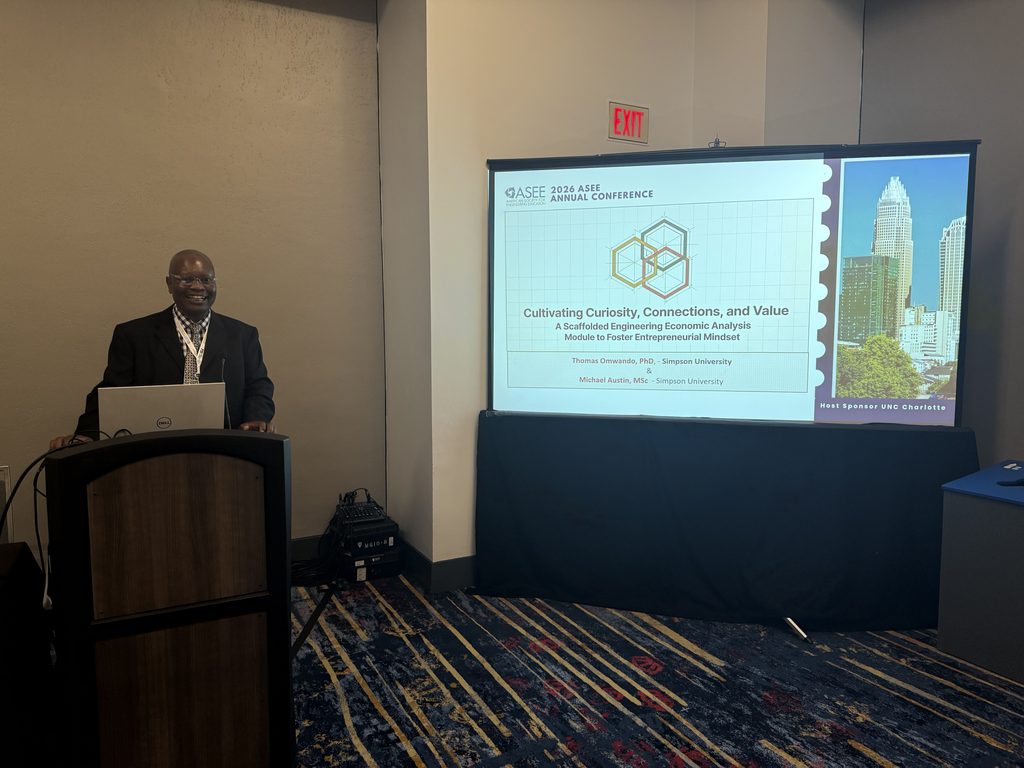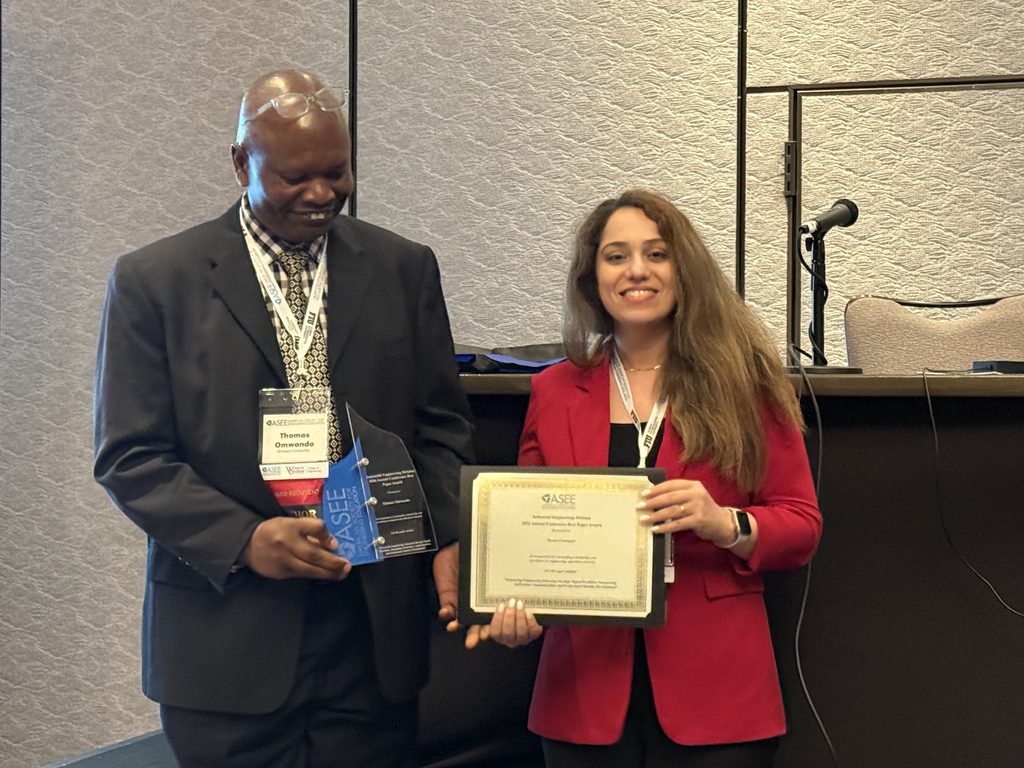
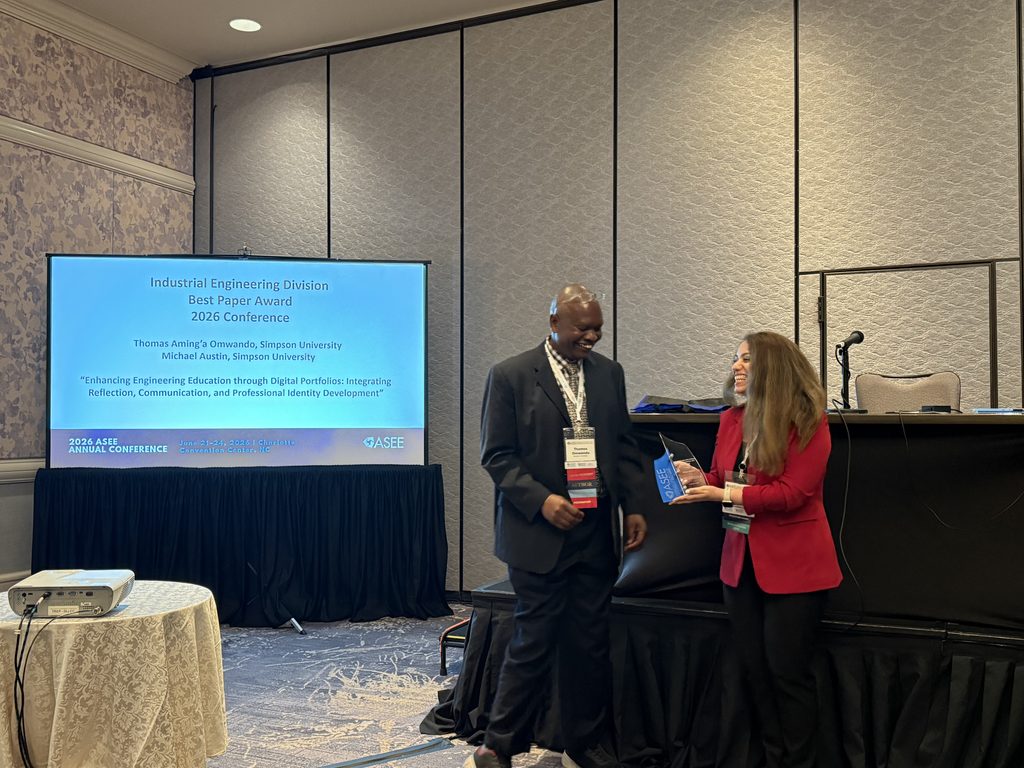
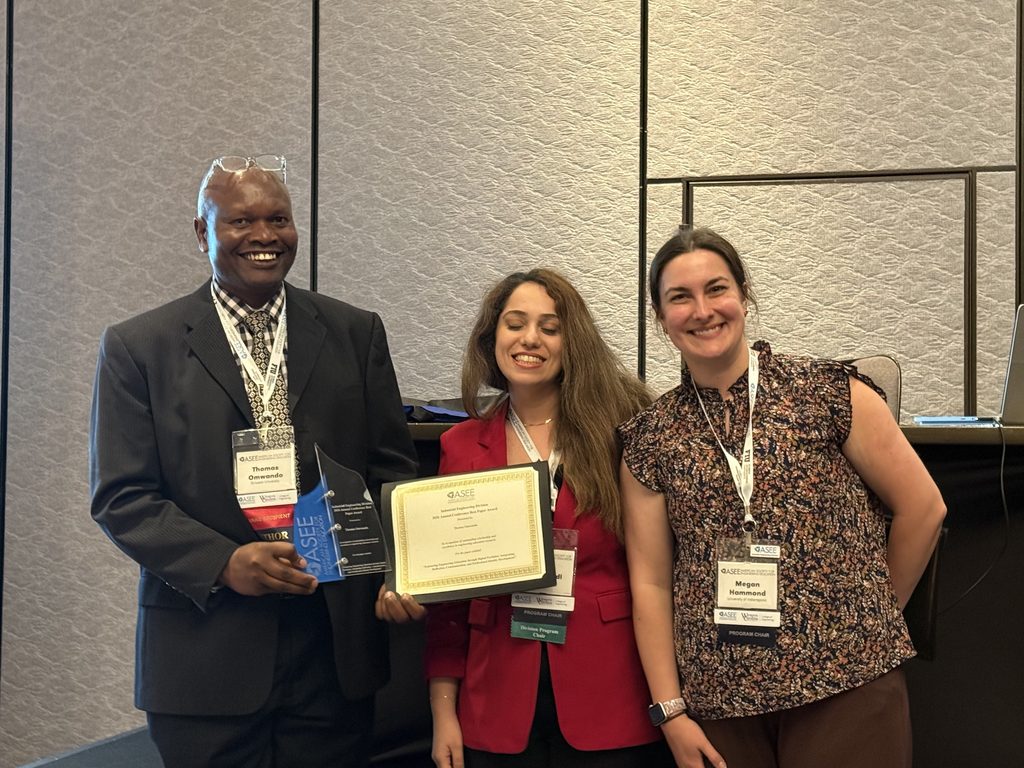
Two research papers from Simpson University’s engineering program took top honors at the 2026 American Society for Engineering Education (ASEE) Annual Conference in Charlotte, North Carolina, beating out submissions from engineering educators from around the world.
Though ASEE began as a national society in the United States, its annual conference now draws engineers and educators from across the globe. Dr. Thomas Omwando, the Engineering Department Chair, co-authored one of the three papers this year with his colleague, Professor Michael Austin.
Dr. Omwando submitted three papers to this year’s conference, with data coming from students in the engineering department. Two were named best paper in their divisions: the Industrial Engineering Division and the Engineering Economy Division. His third paper was submitted to the First-Year Programs Division.
The wins build on Omwando’s 2025 best-paper award in the Industrial Engineering Division. Simpson Engineering has now earned three ASEE division best-paper awards: two in Industrial Engineering and one in Engineering Economy.
“This is a testament that our program is preparing students for the job market and for graduate school,” Omwando said.
From one student to 42
Omwando has spent the last five years in Simpson’s engineering department and has watched it grow firsthand.
“When I came here, the first class that I had, I had a class of one student,” he said. “And now, right now we have a total of 42 students in the program. So there has been tremendous growth.”
The engineering department at Simpson University is still in the beginning stages, as it launched in 2019. The first student to graduate from the program was in the fall of 2024, followed by two more students in the spring of 2025.
The department is preparing for a visit from the professional accreditation body.
“We are anticipating that we have done our best and the program will be accredited by the professional accreditation body, and if that happens, the program will get more visibility, and we expect to get more students,” Omwando said.
Learning by building
Hands-on projects are a cornerstone of Simpson’s engineering curriculum. In their third year, students take an engineering design and product development course in which they design products, build and test prototypes, and recommend improvements.
Seniors then take on a two-semester capstone project, developing solutions to real problems facing developing countries. One recent team designed a water filtration system for rural Ecuador. Their biggest challenge was making the system work without electricity.
Students in the capstone project work directly with practicing engineers, who give feedback on how their designs would hold up in the real world. Teams then build a prototype and test it.
Research rooted in the classroom
Omwando’s papers grow out of data he gathers from students throughout the school year. Students are surveyed before a project begins and again after it ends.
The surveys ask whether the project taught students more about how to be an engineer, whether engineering feels like the right fit for them, and whether they plan to keep pursuing the field. Beyond the conference papers, the findings help Simpson keep improving its engineering curriculum.
How the new building will help the department grow
The program expects more growth soon. The new Hugh and Hazel Darling Center for Business, Technology, and Engineering opens Oct. 16, 2026, adding space for labs and equipment. The new building will have a specialized computer lab area for engineering students to design their projects. There will also be a welding room to work on metal projects, and a room specifically for wood projects. The new building allows space for a 3D printer, giving students access to an entire room to work with that technology. There is also a brand new classroom, giving the department room to grow in class size in the future.
As the program grows, Dr. Omwando aims to submit at least one paper to ASEE each year. He has already collected data from a summer internship class he taught and is gathering more from other courses this school year.